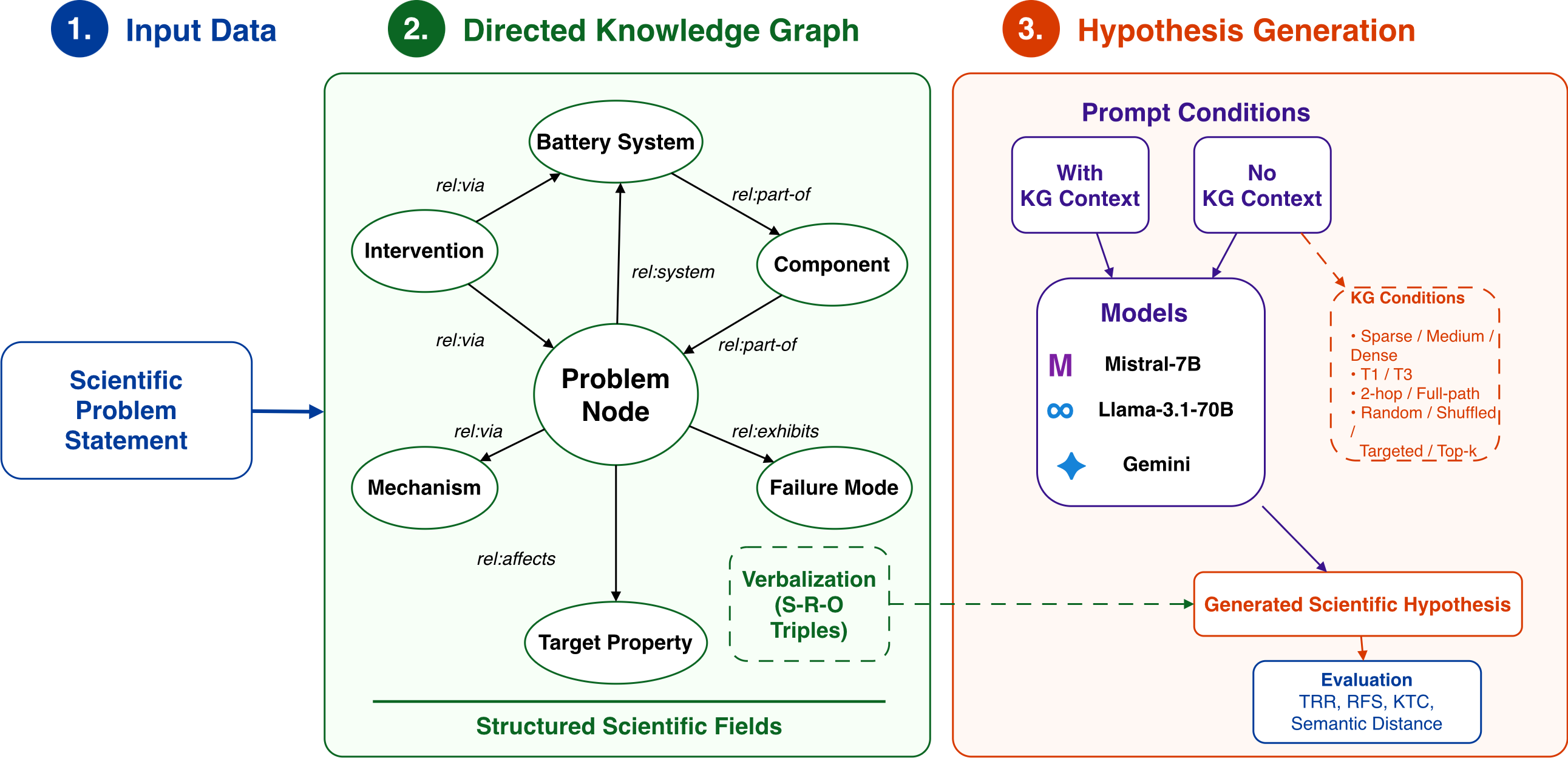
A knowledge graph describes entities and their relationships explicitly. For a scientific language model, it can supply structured context alongside a question. But a larger graph also includes more redundant or distracting information. This study asks which graph facts actually affect the generated hypothesis.
Changing the context, not just the prompt
We study battery-materials hypothesis generation across Mistral-7B, Llama-3.1-70B, and Gemini 2.5 Flash. The experiments vary how many facts are supplied, how detailed the relationships are, and how the graph is connected. Full-graph and no-graph conditions provide important comparison points.
Imagine giving someone an entire collection of research notes versus a short selection of relevant relationships. If both lead to a similar explanation, that suggests the larger collection contains redundancy. It does not, by itself, prove that the selected relationships are the only important ones.
Compact context can preserve much of the signal
Compact top-k subgraphs often approximate full-graph behavior. The study examines generated outputs using measures of graph content and semantic similarity, including settings where claimed-outcome facts are withheld. The effect is selective and depends on the model.
An important control complicates the story: random and topology-based subsets can recover substantial signal too. Models without supplied graphs can also reproduce graph content from their existing knowledge. That makes it difficult to credit every successful answer to a particular fact-selection rule.
A practical question for scientific workflows
The findings motivate testing whether a smaller context can serve a task as well as a larger one. The appropriate comparison includes alternative subsets and a no-graph baseline. Reproducing graph content is informative, but judging whether a hypothesis is scientifically useful still requires a broader evaluation.