A model can generate a convincing scientific hypothesis without offering a dependable way to evaluate it. This study asks a narrower, measurable question: given a paper’s background and research question, can a model identify the hypothesis that belongs to that study?
Scoring instead of asking for a verdict
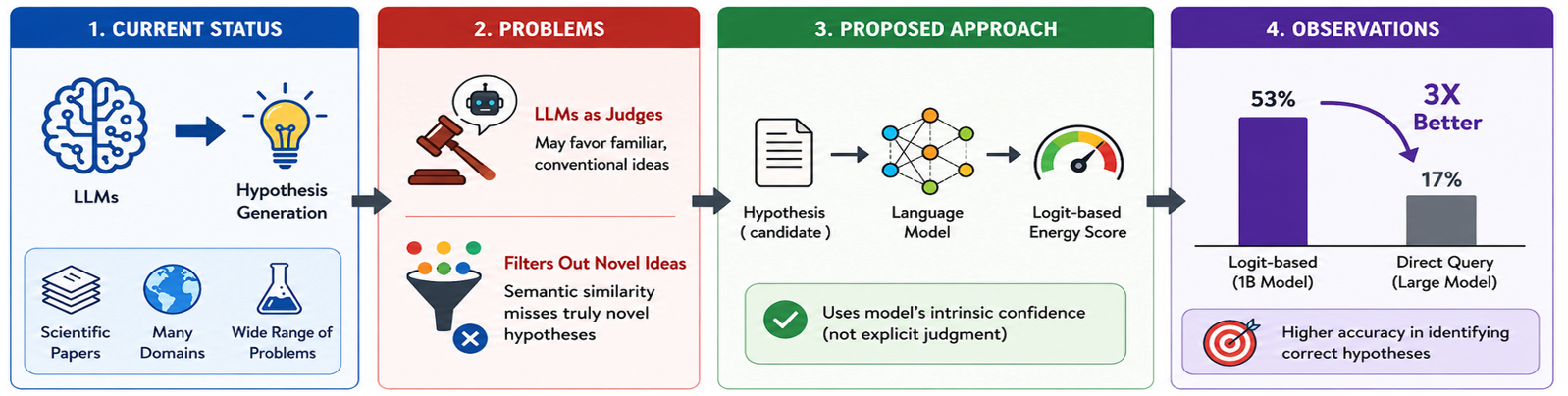
A prompted judge compares alternatives and returns a choice or ranking. Our alternative scores each candidate using signals from the model’s token predictions. The study examines normalized likelihood and raw target-logit energy, measuring how the model responds to the hypothesis text under the same background context.
Think of this as comparing two ways to assess an answer: ask the model to explain its preference, or inspect the numerical signal produced while it processes the candidate. These are different measurements, and neither should be confused with an experiment that verifies the scientific claim.
Reading the benchmark carefully
The evaluation covers seven models and 1,323 papers across 12 disciplines. Each paper has its associated hypothesis and fifteen incorrect alternatives. Pooled intrinsic scoring reaches 33.0% Hit@1, compared with 16.6% for prompted listwise ranking. Hit@1 means the correct hypothesis was placed first.
The strongest configuration reaches 53.1%, but it is the best result selected from 14 model-by-scorer combinations. It is not the average performance of the method. Reporting that selection context is necessary to interpret the figure fairly.
Recognition is not discovery
These findings support further work on intrinsic scoring for hypothesis evaluation. They do not establish that a high-scoring new hypothesis is true, original, or experimentally feasible. Selecting an existing hypothesis from alternatives is a useful test, but open-ended scientific discovery asks more of the system.