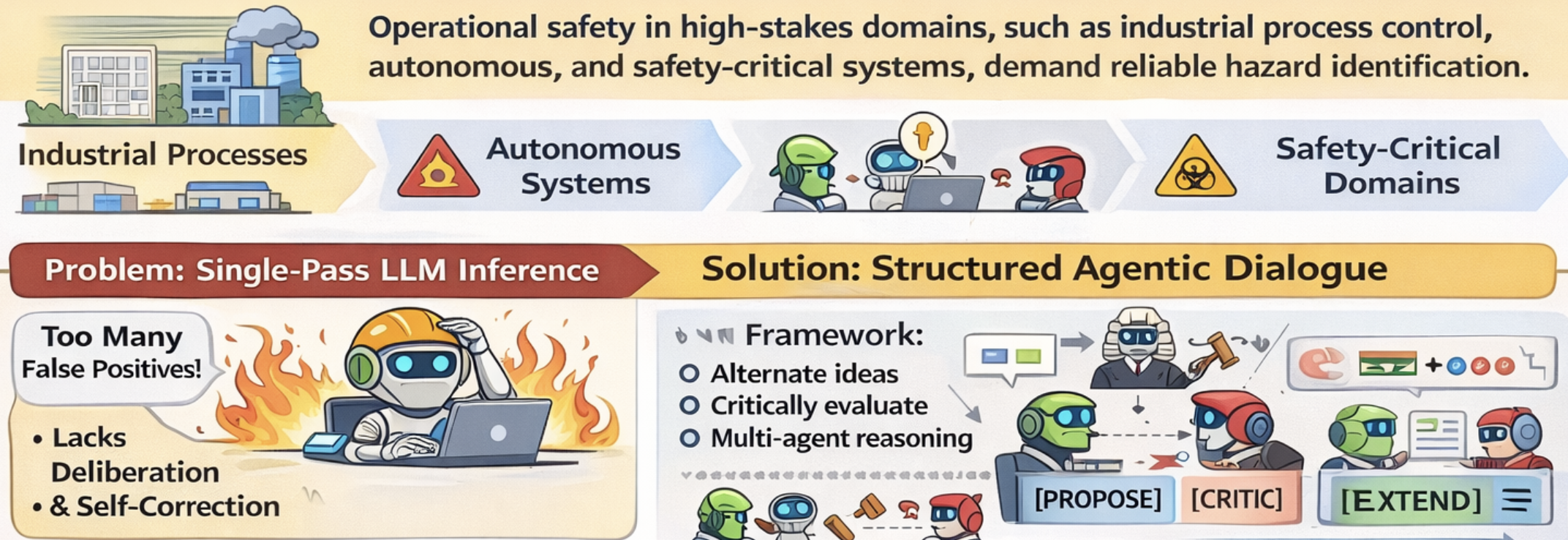
A safety review usually involves questions, objections, and revisions. A language model asked to identify hazards in one pass has no comparable review process. HAZDIAL studies whether a structured conversation between agents can improve that analysis.
What the agents actually do
We compare a single-prompt baseline with two dialogue designs. In debate, a proposer identifies hazards and a critic challenges the suggestions. In constructive discussion, an analyst and reviewer work together to refine the answer. The distinction is practical: challenging an unsupported hazard is different from helping another agent find one it missed.
The framework also explores evolutionary optimization of the dialogue policy. Instead of assuming one agent configuration works best, the search adjusts aspects of the interaction and scores the resulting behavior. Its recall-oriented objective gives extra weight to avoiding missed hazards.
More conversation is not automatically better
The evaluation uses a curated hazard dataset and examines precision, recall, and F1. Precision asks how many proposed hazards are correct; recall asks how many relevant hazards were found. In a safety setting, both matter: false alarms consume attention, while omissions leave risks unexplored.
Results vary with the model and dialogue structure. Debate performs well for the smaller open model, while cooperative discussion can underperform its baseline. With GPT-4.1, discussion improves recall. The lesson is to evaluate the interaction design, rather than treating additional agents as an improvement by themselves.
The boundary of the result
This is a study of hazard identification under defined evaluation conditions. Matching predicted hazards to reference labels and interpreting dialogue traces introduce limitations. A plausible exchange is still not evidence that an operation is safe; engineering judgment remains necessary.