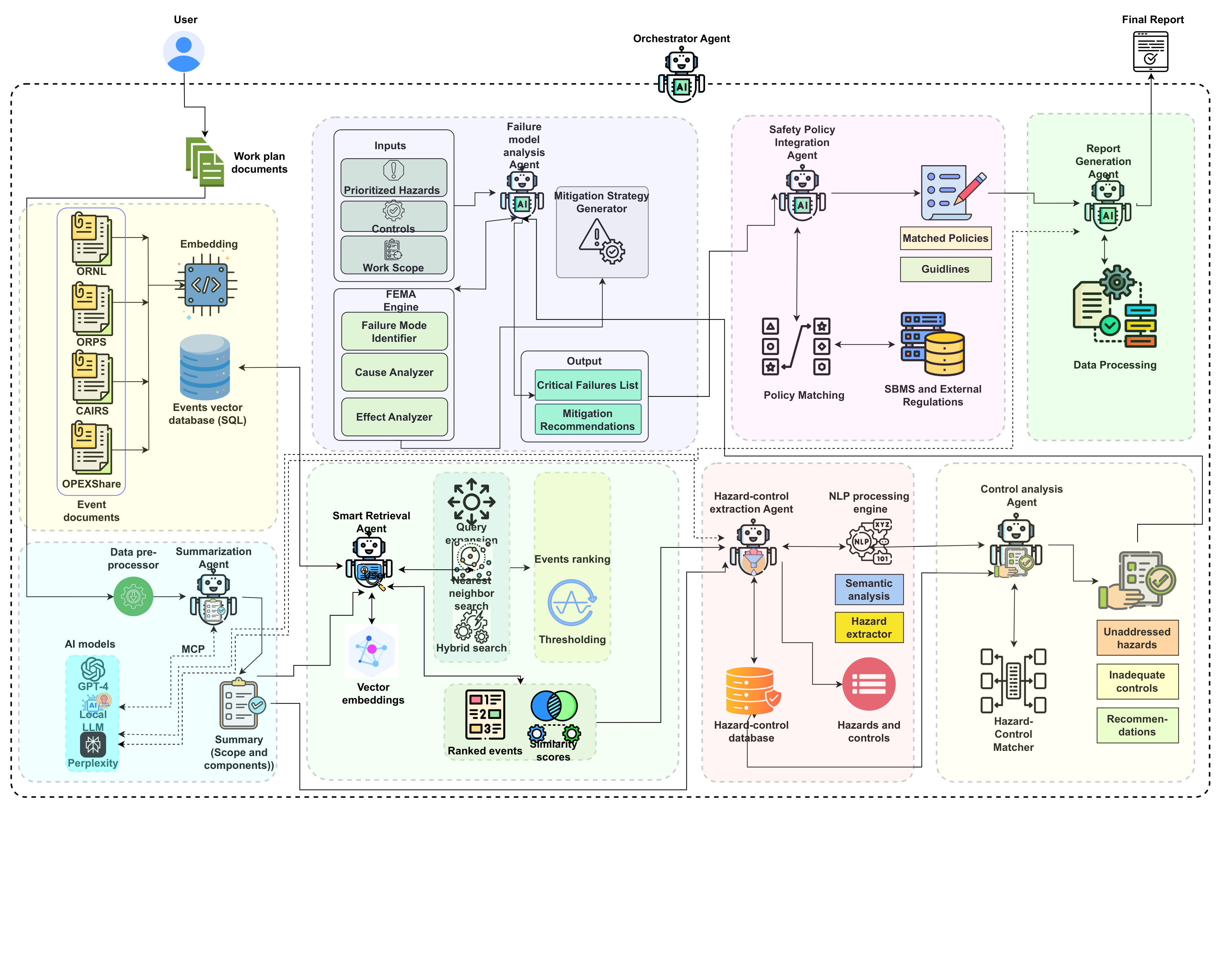
An incident report is useful only if its lessons reach the next person facing a related task. In a large technical organization, that can mean finding relevant evidence across years of reports and connecting it to a new work description. HARNESS studies an AI-assisted workflow for that problem.
From a work description to relevant evidence
The framework combines structured work information, retrieval of historical events, language models, and risk analysis. Retrieval supplies potentially relevant past incidents, giving the reasoning process evidence beyond the wording of the current task.
Consider a hypothetical maintenance job involving equipment isolation. A useful system would need to connect the task description with relevant earlier incidents, then explain which hazards deserve review. This example illustrates the retrieval problem; it is not a reported HARNESS deployment case.
Experts are part of the workflow
HARNESS includes a human-in-the-loop mechanism through which subject matter experts review and refine predictions. Their input can help distinguish a meaningful connection from a superficial similarity between two reports. Feedback also supports an iterative process rather than a one-off answer.
This distinction matters because historical evidence is incomplete. Reports may describe similar equipment under different conditions, and a past event may be irrelevant to the current procedure. A useful prediction must be evaluated in context, with the available operational information.
What the paper establishes—and what comes next
The paper presents a modular architecture and describes preliminary deployment as promising. Quantitative prediction accuracy, agreement with subject matter experts, and decision latency remain evaluation priorities. It should be read as an account of the framework and its direction, rather than evidence of a measured reduction in workplace incidents.